The context window, rebuilt
What filled it, in what order, and what a compaction threw away. You finally see where the tokens go.
The control desk for your Claude Code environment. Local, no account, no outgoing call.

Claude Code writes a great deal into ~/.claude, and shows almost none of it.
Your agents, your skills, your hooks, your MCP servers, your permissions live in a handful of JSON and Markdown files edited blind. Your sessions, for their part, leave behind .jsonl transcripts of several megabytes — the full account of what the model read, thought, attempted and spent — that nobody ever reads.
AURA opens that folder. It is a local web application that inventories your resources, watches your sessions live, replays the old ones line by line, prices what they cost, and tells you which ones deserved an action. It runs on your machine, talks to no outside service, and never changes a file without showing you the diff first.
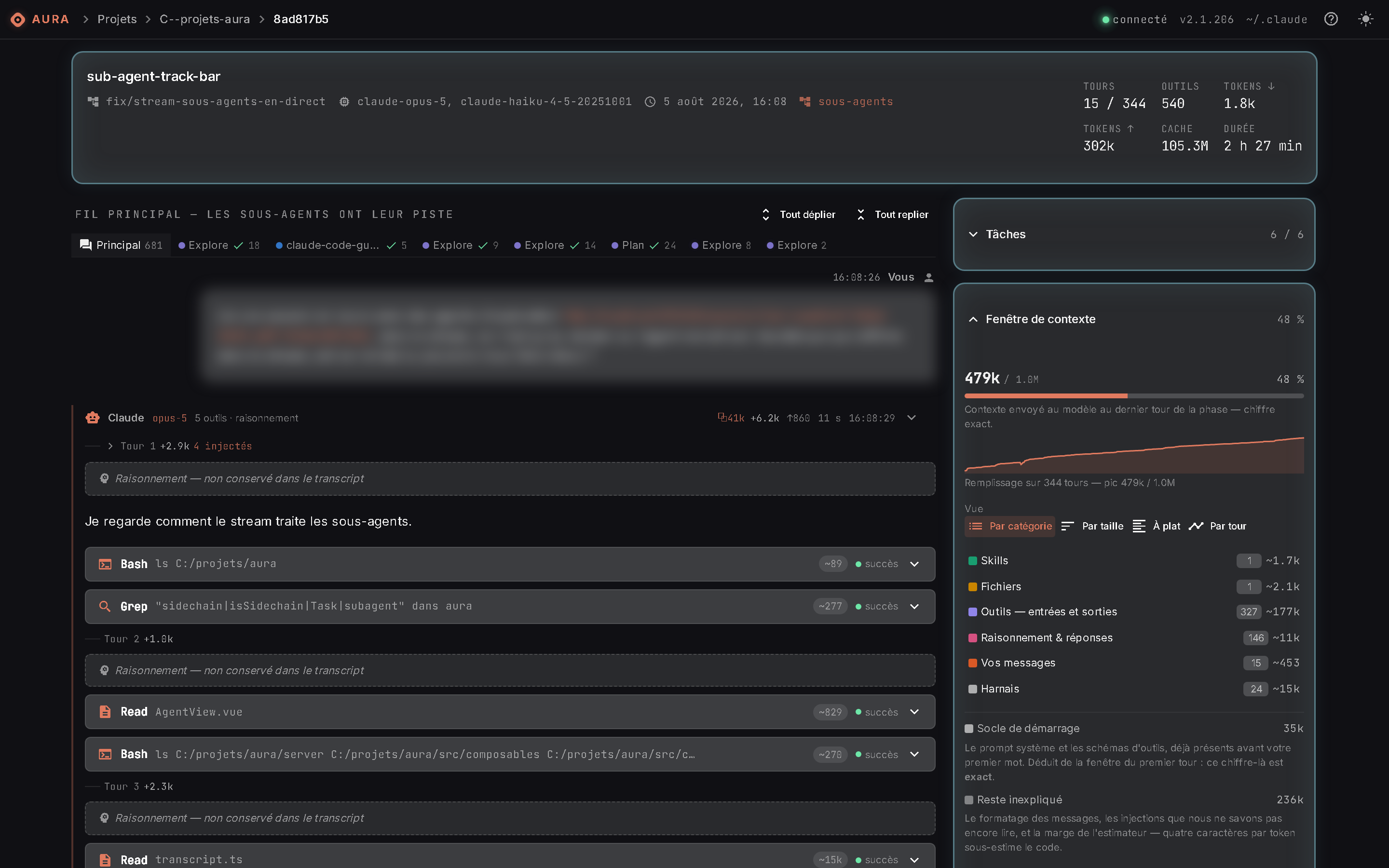
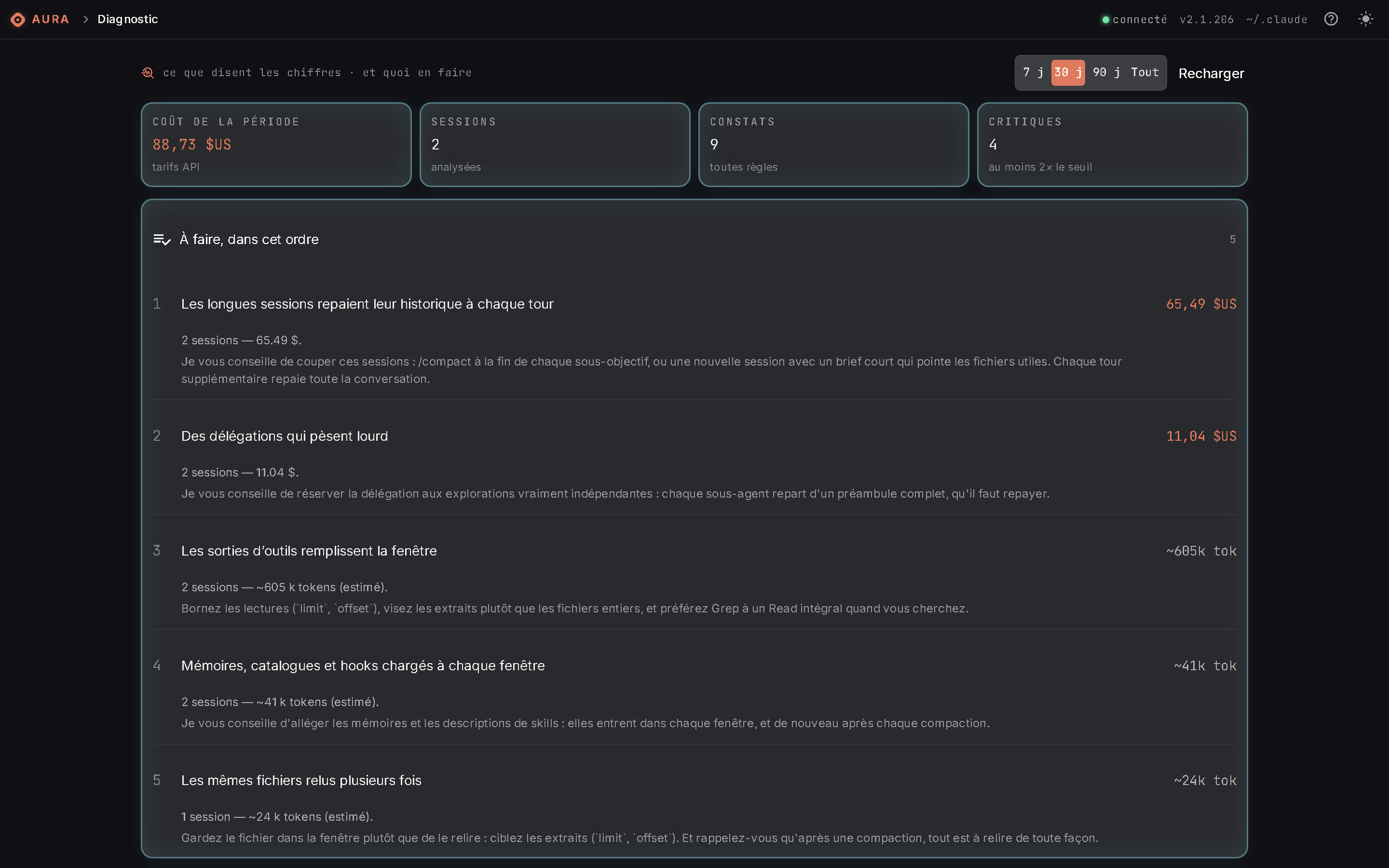
The screenshots use an anonymised demonstration dataset. The interface is shown in French; it also runs in English.
There are a good half-dozen dashboards that read your transcripts and tell you what Claude Code costs you. They do it well. AURA overlaps them on that ground, but that is not where it is decided.
| Usage counters | Config managers | AURA | |
|---|---|---|---|
| Tokens, costs, charts | yes | — | yes |
| Edit agents, skills, hooks, MCP, settings | — | yes | yes |
| Full replay of a session | sometimes | — | yes |
| Context window rebuilt | — | — | yes |
| Sub-agent tracks kept separate | — | — | yes |
| Diagnostic calibrated on your corpus | — | — | yes |
| Diff + backup before every write | — | sometimes | yes |
| Run a session from the interface | — | — | yes |
The two left-hand columns describe families of tools, not named projects: the comparison stays true when one of them adds a feature.
AURA modifies files that govern the behaviour of an autonomous agent on your machine. The contract is therefore explicit, and it holds in four guarantees.
1. Every write is previewed. The server computes the resulting content and returns a line-by-line diff. Nothing is written until you confirm.
2. Every write is reversible. The previous version goes, timestamped, into .local/backups — next to the application, never inside ~/.claude. Deletions included.
3. A concurrent write is never overwritten. If the file moved on disk between the proposal and the confirmation, the confirmation is refused.
4. The write perimeter is an allowlist, deliberately short. Inside ~/.claude: settings.json, CLAUDE.md, and the agents/, skills/, projects/ folders. Everything else is read-only. Facing it, a read denylist: .credentials.json is never read, nor exposed, nor backed up.
The detail is in Concepts — five minutes, and you will know exactly what AURA allows itself to write, to read, and to refuse.
You need Node.js 24, pnpm ≥ 11, and an existing ~/.claude folder — so Claude Code installed and run at least once. Developed and tested on Windows, exclusively.
git clone https://github.com/Shaenn/aura.git aura
cd aura
pnpm install
node lancement/lancer.mjs dev
The application opens on http://127.0.0.1:9788. To stop it: Ctrl+C, or node lancement/arreter.mjs from another window — a Workshop session runs a claude process, and that is the only gesture which, on Windows, triggers an orderly shutdown.
Keep your transcripts, or AURA has nothing to show
Claude Code prunes on its own any session untouched for 30 days. Before anything else, extend that retention in ~/.claude/settings.json:
{ "cleanupPeriodDays": 3650 }Not a single line of this repository was typed by hand. Everything — the server, the SPA, the tests, the manual — was written by Claude Code, under human direction: the specification, the trade-offs, the refusals and the reviews are mine, the code is its.
It is a choice, not a confession. The practical corollary: judge the repository like any other. If it has a bug, it is a bug.